
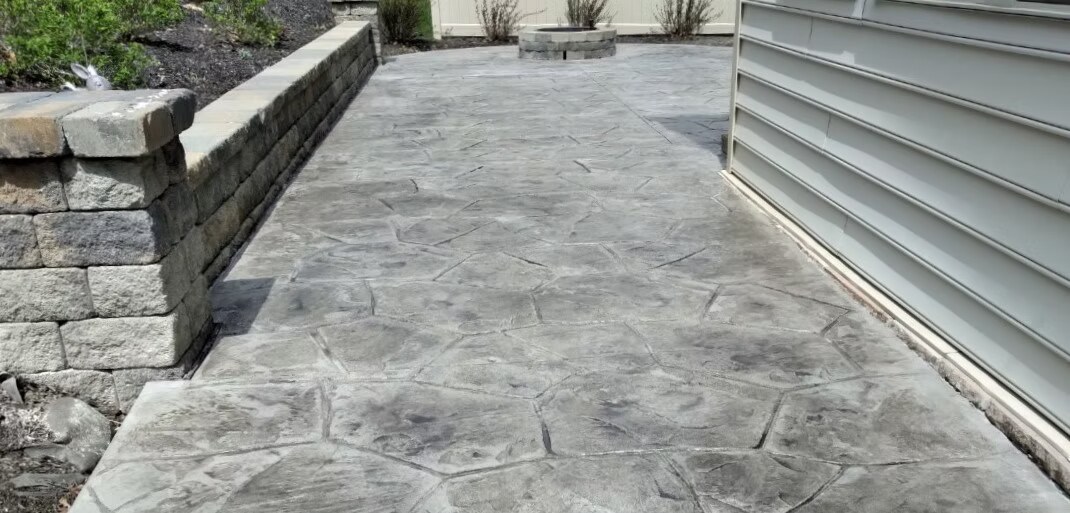
Stamped Concrete vs Pavers: What Holds Up in Pittsburgh Winters
This is the most common question we get on patio and pool deck projects, and most of the answers online are written by someone selling one of the two. Both are good products. They fail differently, they cost differently, and they ask different things of you over twenty years. Here is the honest comparison for Western Pennsylvania specifically.
The Short Version
Stamped concrete costs less installed, gives you a continuous surface with no joints, offers a wider design range, and needs resealing every few years.
Pavers cost more installed, will not crack because each unit moves independently, can be lifted and reset for repair, and need ongoing joint maintenance against weeds, ants, and settling.
If you will commit to resealing, stamped concrete is usually the better value here. If you will not maintain anything at all, neither one stays attractive, but pavers degrade more gracefully.
How Each Handles Freeze and Thaw
Western PA runs roughly forty to fifty freeze and thaw cycles a year, and that is the defining test.
Stamped concrete is a single slab. It has control joints to direct shrinkage cracking, and properly built with air entrained mix and a compacted base it handles freeze and thaw well. Its vulnerability is the textured surface, which gives water and chloride more area to work on than a flat broom finish. Sealer is what protects it, and an unsealed stamped surface will deteriorate faster than plain concrete would.
Pavers are individual units over a compacted base with jointing sand. There is no slab to crack, and freeze heave moves units rather than fracturing them. Their vulnerability is the base and joints. Over years of freeze cycles, units can settle unevenly, joint sand washes out, and the surface develops the low spots and lipping you see on older paver installations.
Neither one is immune. They just show their age in different places.
Cost Up Front and Over Twenty Years
Stamped concrete costs less to install per square foot. That gap is real and it is the reason a lot of people choose it.
Over twenty years the picture narrows. Stamped needs resealing every two to three years in this climate, and that is a recurring cost. Pavers need periodic joint sand replenishment, weed control, and occasional resetting of settled areas, which is also a recurring cost, generally more labor and less material.
The comparison that actually matters is not which is cheaper on day one, it is which maintenance regime you will realistically keep up with. A stamped patio that gets resealed on schedule outlives a paver patio that nobody ever touches, and the reverse is equally true.
Repair Is the Real Difference
This is where the two genuinely diverge, and it deserves more weight than most comparisons give it.
If a paver settles or cracks, you lift that unit, fix the base, and set it back. The repair is close to invisible.
If stamped concrete cracks, you have a crack in a decorative surface, and matching existing stamped work exactly is difficult. Color has weathered, the release pattern was unique to that pour, and a patch is going to be visible. What we can do is keep water out of it and improve the look. What nobody can do is make it disappear.
If the idea of a visible permanent patch bothers you, weight that heavily.
Weeds, Ants, and Joints
Paver joints are a maintenance item. Weeds germinate in them, ants nest in them and undermine units from below, and jointing sand washes out over time and has to be replenished. Polymeric sand helps considerably and does not eliminate it.
Stamped concrete has none of that. It is a continuous surface with control joints that are sealed. For a lot of homeowners this alone decides it, particularly around a pool deck where you are walking barefoot and would rather not meet an ant colony.
Design Range
Stamped concrete can imitate ashlar slate, random flagstone, running bond and herringbone brick, cobblestone, and wood plank, in a wide range of colors with antiquing that produces genuine depth. It can also do curves, radii, and custom borders that pavers handle awkwardly.
Pavers have their own look, and a well laid paver installation with quality units reads as substantial in a way that concrete does not quite replicate. On some architecture, particularly around older homes in Sewickley or Mt. Lebanon, that matters.
Wood plank is worth singling out. Pavers cannot do it. If you want a deck look without deck maintenance, stamped is the only option of the two.
Which for Which Project
For patios, stamped concrete is usually the better value in this market, especially at larger sizes where the cost gap compounds.
For pool decks, stamped with a slip resistant sealer additive is our usual recommendation, mostly because of the joint and ant issue and because a continuous surface is easier to keep clean around a pool.
For driveways, stamped concrete generally wins on cost at driveway scale, though a broom field with a stamped border gets you most of the visual benefit for much less.
For small accent areas, walkways, and situations where you expect to dig something up later, pavers make good sense.
Decorative work is the part of this trade Dave enjoys most. Call (412) 983-3445 and ask him what actually suits your property.
(412) 983-3445