
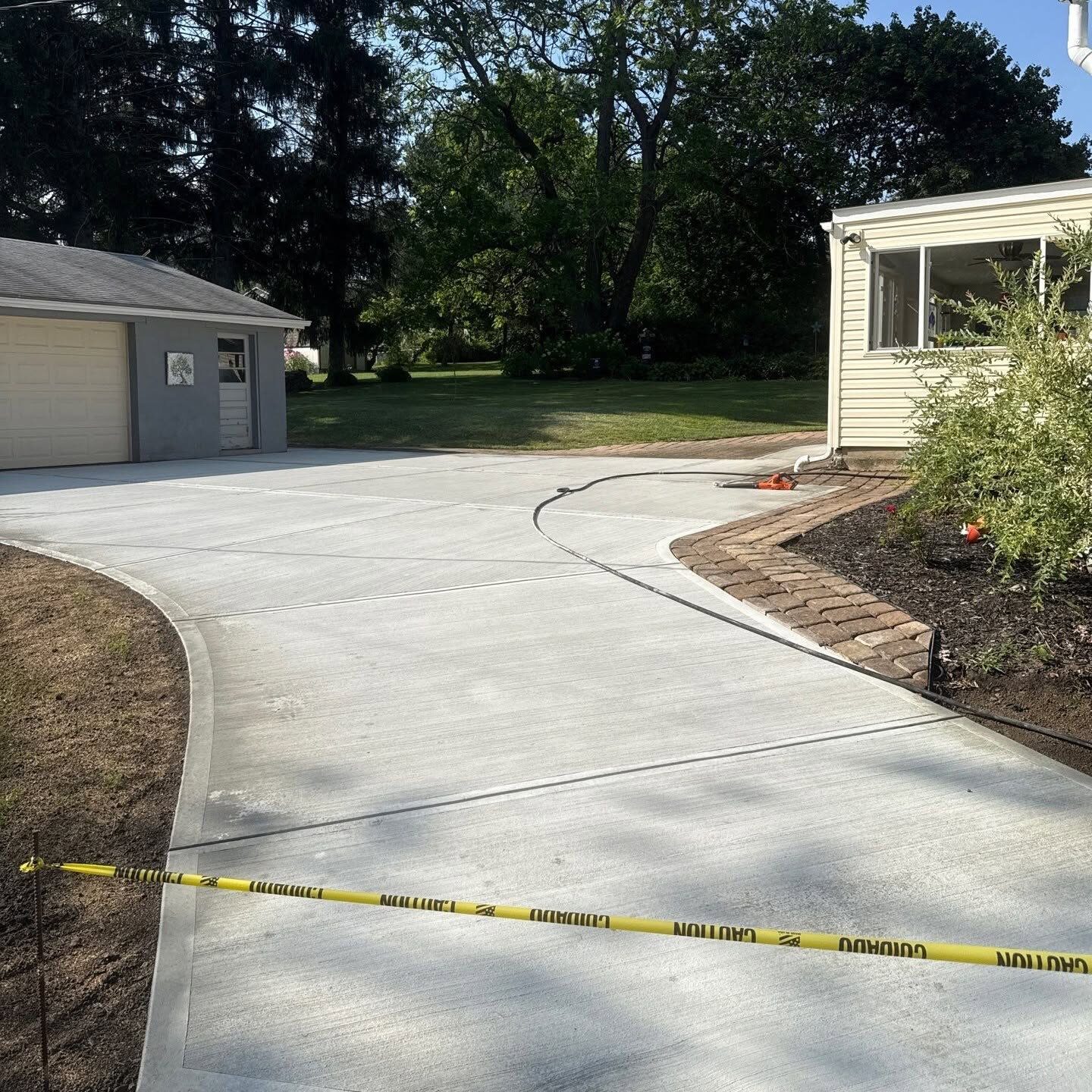
What Drives Concrete Driveway Cost in Beaver County
The first thing almost everyone asks is what a driveway costs per square foot. It is a reasonable question and the honest answer is that the number varies enough between properties that quoting one without seeing the job would be misleading. What is genuinely useful is understanding what moves the number. Once you know that, you can look at two estimates and tell whether they are actually pricing the same work, which is the thing that matters most when you are comparing bids. Here is what goes into it.
Square Footage Is the Starting Point, Not the Answer
Area sets the baseline for material and labor, and bigger jobs price better per square foot than small ones because mobilization and setup spread across more surface. A large driveway is not proportionally more expensive than a small one.
But square footage alone explains maybe half the variation between two driveways of the same size. Everything below explains the rest.
Tear Out and Haul Away
If there is existing concrete or asphalt, it has to come out and go somewhere, and that is real cost in labor, equipment, and disposal.
Thickness matters here. Breaking out a four inch slab is a different job than breaking out something poured much heavier decades ago. Reinforcement matters too, since heavily reinforced old concrete is slower to remove. And whether a machine can reach the slab to break it changes the labor substantially.
People are sometimes surprised that removal is a meaningful line on the estimate. It is, and any bid that seems to have skipped it is worth asking about.
What the Ground Underneath Costs You
This is the part nobody sees and the part that decides whether the driveway lasts.
A slab is only as good as what it sits on. Excavating to proper depth, removing unsuitable material rather than pouring over it, bringing in aggregate base, and mechanically compacting that base all take time and material. Sites that need extra excavation, additional fill, or drainage correction cost more.
It is also the easiest place for a low bid to save money, because you cannot inspect it after the pour. If one estimate is meaningfully cheaper than the others, ask both contractors to specify base depth and compaction in writing. That question tends to explain the difference.
Thickness and Reinforcement
Four inches is the residential minimum. If you park a full size truck, an RV, a trailer, or a boat, five or six inches with appropriate reinforcement is the right specification.
The extra concrete is a modest percentage increase on the total. Replacing a driveway that cracked because it was poured thin for the weight it carries is not modest. Tell your contractor what you actually park, including the vehicle you might buy in three years.
Reinforcement type varies with the job, and what matters as much as the type is that it is positioned correctly within the slab rather than lying on the base doing nothing.
Finish Changes the Number Significantly
A broom finish is the baseline and it is the right answer for most driveways. It gives traction on a wet sloped surface and it hides minor variation.
Exposed aggregate costs more. Stamped and decorative costs meaningfully more again, because it adds color materials, release agent, substantial stamping labor, and sealing. A middle option a lot of people land on is a broom field with a stamped or contrasting border, which changes how the property reads at a fraction of a fully stamped driveway.
Access Is the Wild Card
In Beaver County and the surrounding hillside communities, access moves the price more than most homeowners expect.
If the truck can place concrete directly, that is the cheap version. If the driveway is up a steep grade, behind a structure, or otherwise unreachable, concrete moves by pump, buggy, or wheelbarrow, and that is labor that has to be paid for. Two identical driveways, one in Beaver borough on a flat lot and one on a steep hillside property, can price quite differently for exactly this reason.
Drainage Work
If water currently runs toward your house or pools in the middle of the driveway, that is a grade problem, and correcting it is part of the job rather than an optional extra.
Sometimes it is handled entirely through slope during grading. Sometimes it needs a drain, a swale, or coordination with downspout discharge. It is worth doing. A perfectly poured driveway that channels water at your foundation is a problem you paid for.
How to Compare Two Estimates
Ask both contractors, in writing:
- What slab thickness are you pouring?
- What is the base depth and how is it being compacted?
- What reinforcement, and how is it supported in the slab?
- Is removal and disposal of the existing surface included?
- Is the mix air entrained?
- What is the joint layout and spacing?
- Is sealing included, and when?
Ultimate Concrete Service gives free written estimates that hold for thirty days, itemized so you can see exactly what you are paying for. Call Dave at (412) 983-3445.
(412) 983-3445