Commercial and Industrial Concrete in Pittsburgh, PA
Structural slabs, loading areas, and site work for commercial properties.
Ultimate Concrete Service handles commercial and industrial concrete work across Allegheny County, Beaver County, and the Greater Pittsburgh region. Dave Felouzis has spent over twenty-five years working both sides of this trade, and the company approaches a large commercial pour with the same standards it brings to a residential sidewalk. From the smallest residential project to a large commercial or industrial job, the prep discipline does not change. Most concrete contractors in this market treat commercial as an afterthought mentioned in one line on a homepage. It is a real part of what we do.
What We Handle on the Commercial Side
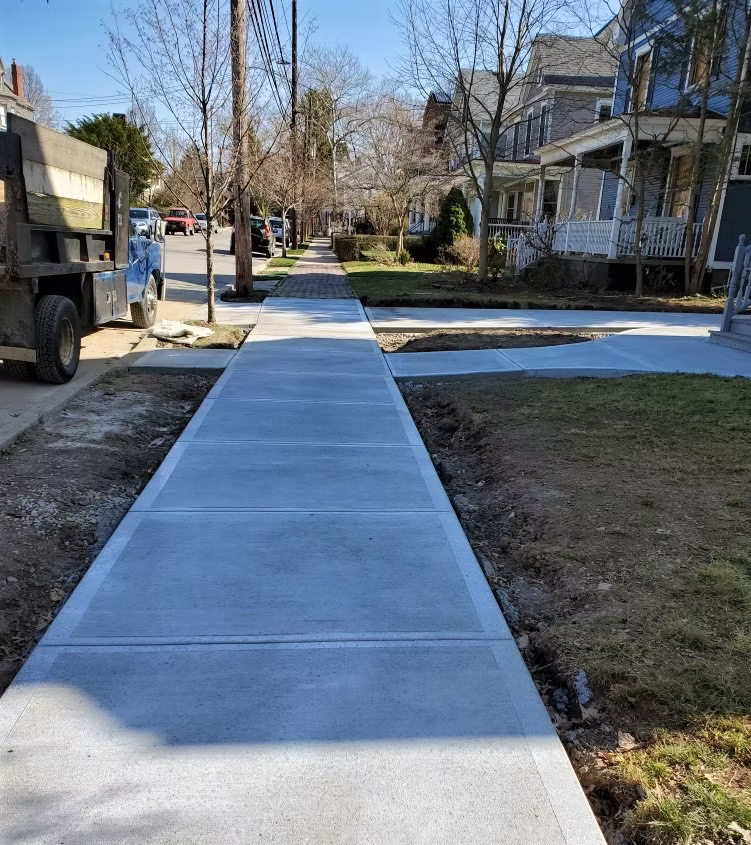
Structural slabs and slab on grade for new construction and replacement. Loading and service areas built for truck traffic. Sidewalks, walkways, and entry aprons for commercial properties. ADA compliant ramps, landings, and accessible routes. Equipment pads and machinery bases. Curbs, aprons, and site concrete. Interior industrial floors. Concrete repair and section replacement on active commercial properties.
We also do excavation as part of site preparation, and sealing where the application calls for it.
If you are a property manager, a general contractor, or a business owner with concrete that needs poured or replaced, call Dave directly at (412) 983-3445 and describe the scope.
Structural Slabs and Load Ratings
The controlling difference between residential and commercial flatwork is what the slab has to carry.
A residential driveway carries passenger vehicles. A commercial service area may carry loaded delivery trucks, forklifts, dumpsters that get dropped and dragged, or stored material with real point loads. Those requirements drive slab thickness, mix strength, reinforcement design, and joint spacing, and they are not something to estimate casually.
Tell us the actual expected loading, including the worst case rather than the typical case. A slab designed for daily van traffic that occasionally sees a loaded semi will fail at the point where the semi turns. Designing for the real maximum up front costs a fraction of replacing a failed section later while the business is trying to operate around it.
Loading Docks, Aprons, and Service Areas
These are the highest stress concrete on most commercial properties and they fail in predictable places.
The apron directly in front of a dock takes repeated heavy loading combined with turning forces, which is a harder condition than straight line traffic. Trailer landing gear concentrates enormous load onto a small footprint. Dumpster pads take impact loading every time a truck sets a container down, plus dragging.
Each of those wants thickness, reinforcement, and joint layout appropriate to the specific abuse it receives rather than a uniform spec across the whole lot. We look at how the property actually operates before pricing, which sometimes means asking to watch a delivery.
ADA Compliance for Commercial Walkways and Ramps
Accessibility is a legal requirement on commercial property, not a preference, and concrete is where most of it lives.
Running slope and cross slope on accessible routes, ramp slope, landing dimensions at the top and bottom of ramps and at doors, level changes at transitions, and clear width all have defined limits. Cross slope is the item that most often fails inspection, because it is easy to build a walkway that meets running slope while pitching too steeply sideways for drainage.
We build accessible routes to those requirements and we would rather resolve a geometry conflict during the estimate, when it is a conversation, than during a pour, when it is expensive. See our sidewalks and steps page for residential accessibility work.
Scheduling Around an Operating Business
Most commercial concrete replacement happens on a property that cannot simply close.
That means the work gets phased. We sequence pours so a portion of the lot, the dock, or the entrance stays usable throughout, and we plan the cure windows around your operations rather than the other way around. Concrete does not negotiate on cure time, so the planning has to happen before we start.
Tell us your constraints early: delivery windows, customer traffic patterns, the days you absolutely cannot lose access, whether night or weekend work is preferable. Those constraints shape the phasing plan and therefore the price, so they belong in the estimate conversation rather than surfacing on day two.
Joint Layout and Long Term Maintenance on Large Pours
On a large slab, joint layout is the difference between a floor that ages well and one that becomes a maintenance problem.
Control joints direct shrinkage cracking. On big commercial pours, spacing, depth, and cut timing all have to be right, and the layout has to account for column locations, re entrant corners at building geometry, and the traffic pattern crossing them. A joint in the wrong place under wheel traffic will spall at the edges.
Construction joints between placements and isolation joints at columns and walls also matter. We plan the layout before the pour, not after.
Ongoing, the highest value maintenance on commercial concrete is keeping joints sealed and addressing spalling early. See concrete repair and resurfacing.
Bidding and Documentation
Commercial work carries paperwork that residential does not, and we handle it as part of the job.
Estimates are detailed and itemized so a property manager or general contractor can compare scope line by line rather than comparing two lump sums that may not cover the same work. We are a registered Pennsylvania Home Improvement Contractor, HIC# PA196507. Public utility marking runs through Pennsylvania 811. Where permits are required, we build to what the municipality specifies.
Estimates hold for thirty days, which matters on commercial jobs where approval has to route through more than one person.
Related Services
Areas We Serve
"Could not be happier with the service and performance of the work. The crew was professional and courteous, and the work was top notch."
Scott Homschek
Google Review
Frequently Asked Questions
Both. We pour structural slabs, loading and service areas, commercial sidewalks, ADA ramps, equipment pads, and site concrete, and we bring the same prep standards to a residential sidewalk.
Yes. Most commercial replacement gets phased so part of the property stays usable throughout. Tell us your delivery windows and the days you cannot lose access, and we build the phasing plan around them.
It depends entirely on what will be on it. Passenger vehicles, forklifts, loaded delivery trucks, and stored material all drive different thickness, mix strength, and reinforcement. Give us the worst case loading, not the typical case.
Yes. Running slope, cross slope, ramp slope, landing dimensions, and clear width all have defined limits, and we build to them. Cross slope is the requirement that most often gets missed, so we work the geometry out during the estimate.
Allegheny County and Beaver County, including Pittsburgh, Moon Township, Sewickley, Beaver, Aliquippa, McCandless, Wexford, Mt. Lebanon, and Bethel Park.
Itemized by scope so you can compare line by line rather than lump sum to lump sum. They are free and they hold for thirty days, which helps when approval has to move through more than one person.