Concrete Driveways in Beaver, PA
Poured, replaced, and finished driveways built for Western PA freeze cycles.
Ultimate Concrete Service pours and replaces concrete driveways throughout Beaver County, Allegheny County, and the Greater Pittsburgh area. Owner Dave Felouzis has been doing this work in Western Pennsylvania for more than twenty-five years, which means he has seen exactly how driveways fail here and exactly what keeps them from failing. A driveway is usually the largest single slab of concrete on a residential property and the one that takes the most abuse, so it is worth understanding what actually goes into one before you sign anything.
When a Driveway Needs Replaced Instead of Repaired
Not every damaged driveway needs torn out. We will tell you when it does not, because we would rather do a smaller honest job than sell you a full replacement you did not need.
Repair usually makes sense when you have isolated cracking with no vertical displacement, a few sunken sections that can be lifted, or surface spalling on an otherwise sound slab. Replacement makes sense when you see a network of cracks across the whole surface rather than in one area, when sections have shifted vertically so one side sits higher than the other, when the slab has broken into distinct chunks that move independently under a vehicle, or when the concrete is deteriorating down through its thickness rather than just at the surface.
The tell most homeowners miss is drainage. If water is pooling in the middle of your driveway or running toward the garage instead of away from it, the problem is grade, and no amount of patching fixes grade. That is a rebuild.
What Goes Under a Driveway Matters More Than What You See
Every driveway failure we get called out to inspect traces back to the same place, and it is almost never the concrete itself. It is what the concrete was sitting on.
A driveway is a slab supported by the ground underneath it. If that ground is soft, uneven, poorly compacted, or full of organic material that will decompose and settle, the slab has nothing to bear against and it will crack no matter how good the mix was. The prep work is where a cheap bid saves money and where you pay for it four years later.
Our process is to excavate to depth, remove unsuitable material rather than pour over it, install and compact a proper aggregate sub base, and confirm the grade runs water away from the structure before a single form goes in. This part of the job is invisible in every photograph anyone will ever take of your driveway, and it is the part that decides whether it lasts.
Thickness and Reinforcement for Western PA
A residential driveway should be poured at four inches minimum. If you park a truck, an RV, a trailer, or anything else with real weight on it, five or six inches is the right call and we will say so during the estimate rather than after the crack shows up.
Reinforcement depends on the job. Wire mesh, rebar on chairs, or fiber reinforced mix all have a place, and the right answer depends on the slab dimensions, the soil, and the load. What matters is that reinforcement is actually positioned correctly in the slab. Mesh laying flat on the sub base does nothing. It has to be held up into the concrete to do its job, and cutting that corner is common.
Mix design matters here too. Western Pennsylvania runs somewhere around forty to fifty freeze and thaw cycles a year. Air entrained concrete builds microscopic voids into the mix that give freezing water somewhere to expand into instead of pushing the slab apart. It is not optional in this climate.
Finish Options for Concrete Driveways
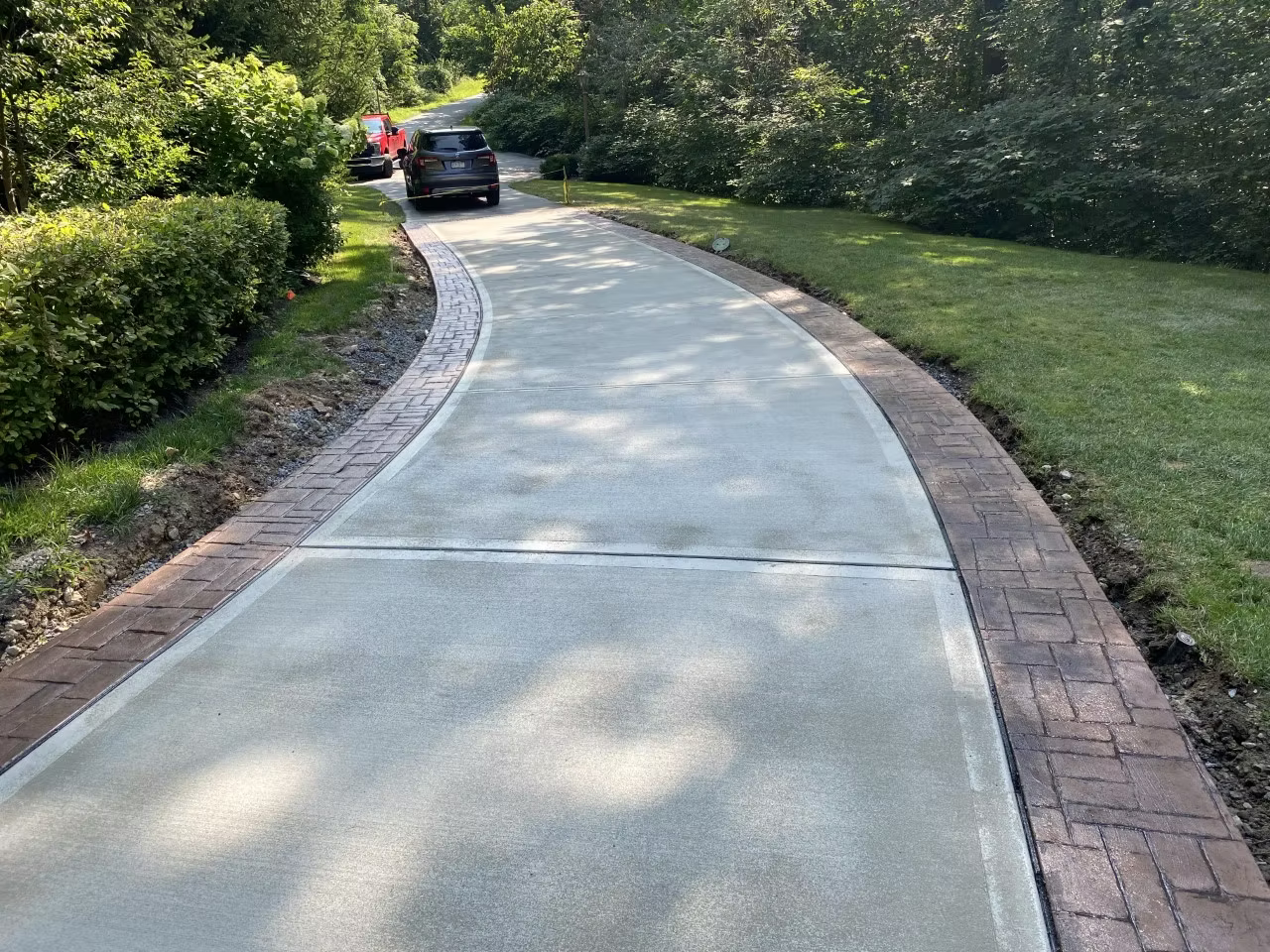
Most driveways around Beaver and Pittsburgh get a broom finish, and there is a good reason for that. It gives you traction on a surface that will be wet, icy, and sloped, and it hides minor imperfections better than a smooth trowel finish.
Beyond broom, we do exposed aggregate for a more textured natural look, and stamped and decorative finishes for homeowners who want the driveway to be a feature rather than a utility. Stamped driveways look sharp and hold up well when they are sealed on schedule, though they carry a higher cost and more maintenance than broom. Dave's favorite work is the decorative side, so if you are considering it, ask him what will actually suit your house. See our stamped and decorative concrete page for the full breakdown of patterns and color options.
We can also cut decorative borders, saw cut patterns into a broom field, or run a contrasting apron at the garage.
What a Concrete Driveway Costs in Beaver County
Price is driven by square footage first, then by everything else: whether existing concrete or asphalt has to be demolished and hauled off, how much excavation and fill the site needs, slab thickness, reinforcement, finish type, access for the truck and equipment, and whether drainage work is required.
A straightforward broom finish replacement on a flat lot with easy access sits at the low end. A stamped driveway on a hillside lot in the South Hills with limited truck access, a tear out, and drainage correction sits well above it. Anyone who quotes you a per square foot number over the phone before seeing the property is guessing.
Dave comes out, measures, looks at the grade and the access, and gives you a detailed written estimate that holds for thirty days. It is free and there is no obligation. For a fuller breakdown of what drives the number, read how much a concrete driveway costs in Beaver County.
Concrete Versus Asphalt in Pittsburgh Winters
Asphalt is cheaper up front and it goes in faster. That is the whole of its advantage.
Concrete lasts significantly longer, handles standing weight better without rutting, does not soften in July heat, and does not need resealing every two or three years to stay intact. Asphalt in Western PA typically needs resealing on a short cycle and full replacement far sooner than concrete does. Over a twenty year horizon, concrete usually costs less per year even though it costs more on day one.
Where asphalt still wins is on very long rural driveways where the up front difference is large enough to matter, and on jobs that need to be usable in a couple of days rather than a couple of weeks.
The Driveway Replacement Process, Step by Step
- 01Site visit and written estimateDave measures, checks grade, drainage, and equipment access, and prices the job in writing.
- 02Utility markingPublic utilities marked through Pennsylvania 811. You tell us about anything private: irrigation, invisible fence, septic.
- 03Demolition and haul offExisting concrete or asphalt broken out and removed.
- 04Excavation and gradingDig to depth, remove unsuitable material, establish the slope that moves water away from the house.
- 05Sub base and compactionAggregate base installed and mechanically compacted.
- 06Forms and reinforcementForms set to line and grade, reinforcement placed and supported at the correct height in the slab.
- 07Pour and finishConcrete placed, screeded, floated, and finished to the chosen texture.
- 08Control jointsCut at correct spacing and correct timing so the slab cracks where we direct it.
- 09CureProtected as conditions require. We tell you exactly when to walk on it and when to drive on it.
Curing and the First Winter
Concrete does not stop gaining strength when it stops being wet. It keeps curing for weeks. Plan on seven days before foot traffic and twenty eight days before you park a vehicle on it. Driving a car onto a new driveway at day ten is one of the more expensive mistakes a homeowner can make.
The first winter matters just as much. Do not use deicing salt on new concrete during its first winter. The surface has not fully cured and chlorides will scale it. Use sand for traction instead. After that first season, be selective with what you put down, and understand that calcium chloride and magnesium chloride products are harder on concrete than most homeowners realize.
If you catch problems early, concrete repair and resurfacing can often extend a driveway rather than replace it. And if you are also planning walkway work, it is usually cheaper to do the sidewalks and steps in the same mobilization.
Related Services
Areas We Serve
"Dave and his crew were very easy to work with. They were punctual, responsive, friendly, respectful to my property, and cared about the quality of their work. The price was fair and they got the work done quickly. Dave worked with me to create a design layout that made the most sense for my needs. Highly recommend!"
Nate Kicinski
Google Review
Frequently Asked Questions
Four inches is the residential minimum. If you park a truck, RV, trailer, or anything heavy, we recommend five to six inches. Dave will tell you which one your situation calls for during the estimate.
Seven days for foot traffic and twenty eight days before parking a vehicle on it. Concrete keeps gaining strength for weeks after the pour, and driving on it early is the fastest way to crack a brand new slab.
Eventually, yes. All concrete cracks as it shrinks and cures. The job is controlling where. We cut control joints at the right spacing and the right time so cracking follows those lines instead of running randomly across the surface.
Sometimes, with the right mix, additives, and blanket curing. But if waiting until spring gives you a better slab, we will tell you that instead of taking the job.
In almost every case the old slab has to come out. Pouring a thin layer over failing concrete transfers the old cracks straight up through the new surface within a season or two.
Beaver County and Allegheny County, including Beaver, Aliquippa, Sewickley, Moon Township, Pittsburgh, Wexford, McCandless, Mt. Lebanon, and Bethel Park.