
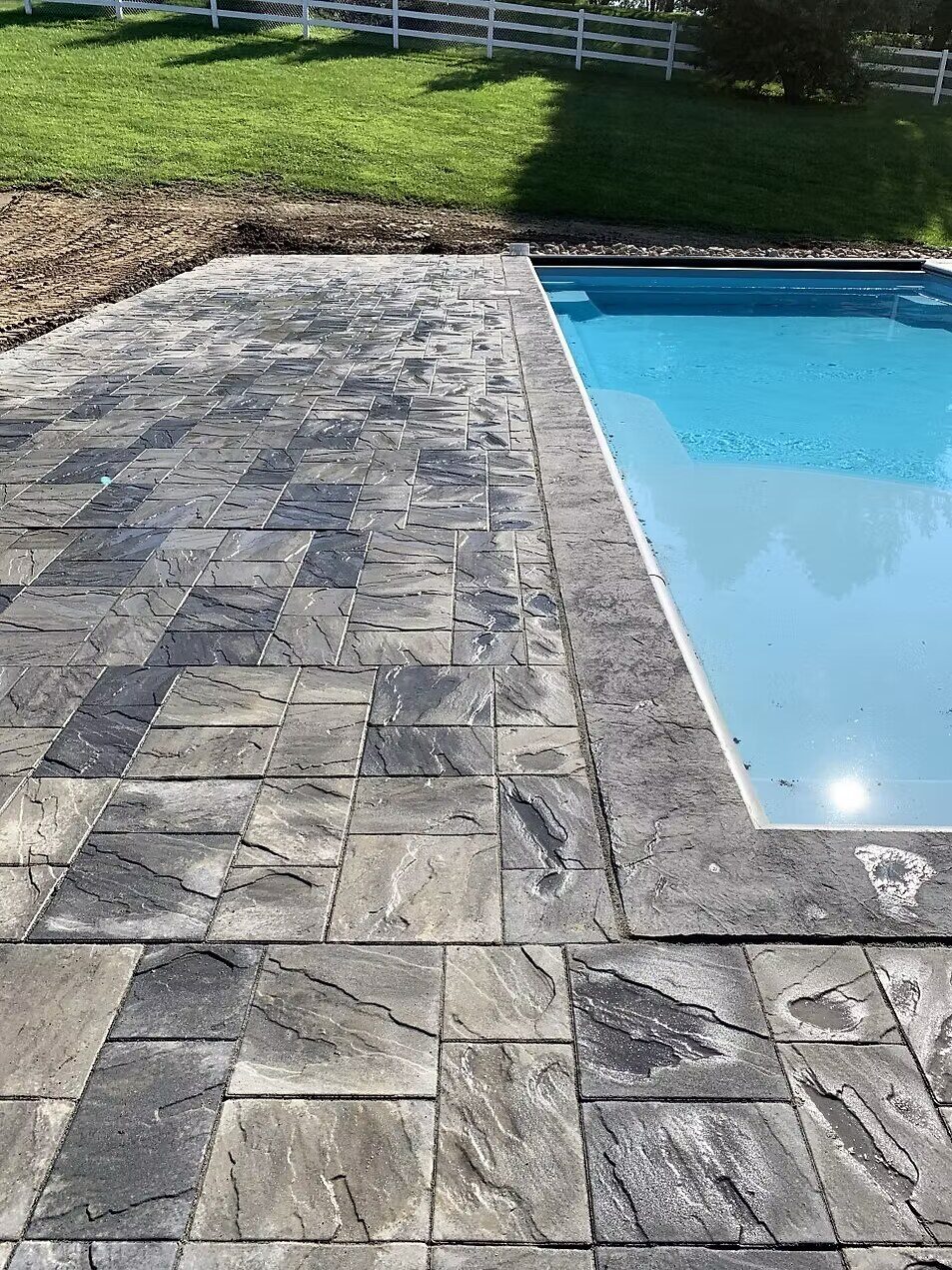
Concrete Pool Decks: Finishes, Slip Resistance, and Cost
A pool deck is the hardest working decorative concrete on a property. It is wet most of the time it is used, walked on barefoot, in direct sun all summer, splashed with treated water, and then sitting through a Western Pennsylvania winter. Most of what determines whether it still looks good at year fifteen gets decided before the pour. Here is what to think through.
Slip Resistance Comes First
This is the only decision on the list that is not about appearance, and it should be made first.
Wet feet on a smooth sealed surface at the edge of a pool is precisely the situation that produces injuries. Whatever finish you choose has to hold traction soaked.
Broom finish gives traction through its texture. Exposed aggregate gives excellent grip through the exposed stone. Stamped finishes look the best and need help: a clear slip resistant additive goes into the sealer, which meaningfully changes traction without changing appearance. We treat that as standard on any pool deck rather than as an upgrade.
Smooth trowel finishes have no business around a pool. If a contractor offers one, that tells you something.
Surface Temperature and Bare Feet
The thing people forget until August.
Dark concrete absorbs substantially more solar heat than light concrete, and the difference underfoot on a hot afternoon is not subtle. A deep charcoal deck can become genuinely unpleasant to cross barefoot in midsummer, and that is now a permanent property of your pool deck.
Lighter tans, buffs, sands, and grays run noticeably cooler. If you want the dark dramatic look, the workable compromise is a light field with darker accent borders, so the surface people actually walk on stays cool while the design still reads as deliberate.
Look at samples outdoors in real sun, not under shop lighting.
The Coping Joint
How the deck meets the pool is a structural detail, not a trim detail.
The pool shell and the deck are separate structures that move independently, and the joint between coping and deck has to be a properly detailed expansion joint that allows that movement. Poured tight against each other with no expansion provision, something cracks, and it is usually the deck.
That joint also has to stay sealed so water does not get behind the coping. It is a maintenance item worth checking every couple of years.
Layout and Deck Width
Think about where people and furniture actually go.
An even narrow strip on all four sides is the default and it is usually the wrong answer. It gives you nowhere to put loungers, a table, or a shade structure, and it makes the whole area feel tight. Most families are better served by a modest walking width on three sides and a genuinely generous area on the one side where furniture will live.
Slope runs away from the pool so deck water and rain do not carry debris and dirt into the water.
Salt Systems Versus Chlorine
Saltwater systems have become common and they are harder on concrete than traditional chlorine.
Salt is aggressive to cement paste and to any embedded steel it reaches. It does not rule out a concrete deck. It means sealing matters more and needs to stay on schedule, and it means telling your contractor which system you run so the right sealer gets specified.
Regardless of system, never use deicing salt on a pool deck in winter. You would be adding chloride exposure to a surface already fighting it every summer.
Backfill, and Why Decks Drop at the Edge
The most common pool deck failure we get called about, and it is entirely preventable.
The soil around a pool is backfill from the excavation, not undisturbed native ground. It settles. A deck poured on poorly compacted backfill drops at the edge nearest the pool, sometimes within a few years.
Compaction before forming is the fix, and it happens before anything visible occurs on the job. This is another one of those items where a low bid saves money in a place you cannot inspect afterward.
Resurfacing an Existing Deck
If your deck is structurally sound but faded, dated, or plain, a resurfacing overlay is often the right call and costs considerably less than a tear out. The new layer can be textured, colored, and stamped.
The requirement is a sound substrate. If the deck has dropped at the edges, cracked through, or is spalling, an overlay is good work on a failing base and the defects reflect through it within a season or two.
What Drives Pool Deck Cost
Square footage sets the base. From there: finish type, color method, whether the backfill needs additional compaction or fill, drainage, the coping expansion joint detail, sealing, and access.
Access is a larger factor on pool projects than most. Pools are in back yards, often behind fencing and landscaping, sometimes up a grade. A yard the truck can reach costs materially less than one where every yard of concrete moves by buggy.
If the pool is not in yet, call before it goes in. There is a right sequence and doing it out of order costs money. We do a lot of this work in Bethel Park and the surrounding South Hills.
Building a pool or replacing a tired deck? Call (412) 983-3445 for a free written estimate.
(412) 983-3445